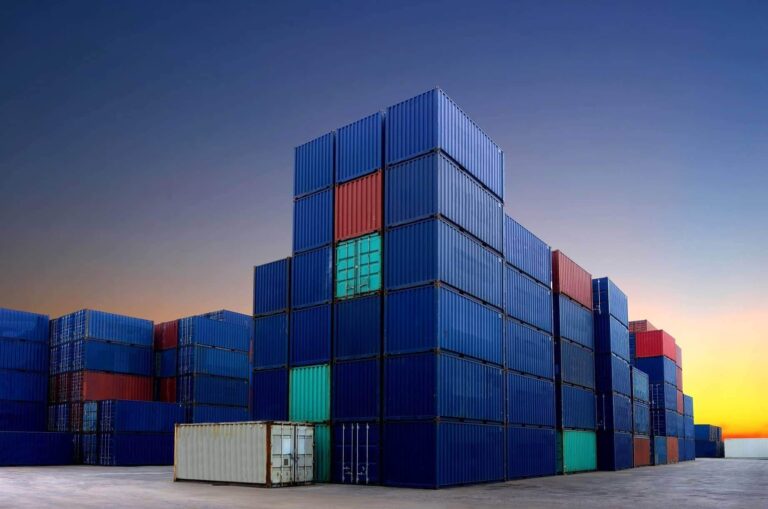
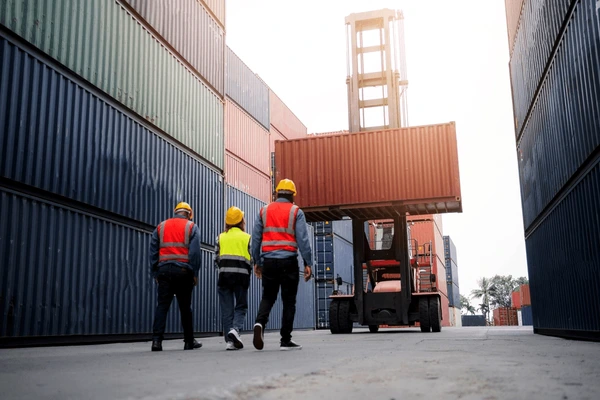
Nigerian ports have never been busier. Total cargo throughput climbed 24.8 percent in 2025 — from 103.6 million metric tons to over 129.3 million metric tons, marking the single largest annual jump in the country’s maritime history.
For anyone moving bulk cargo through this market, that number is not just a statistic. It is a signal of how much opportunity and how much competition for berth space, infrastructure, and logistics capacity are now concentrated at Nigeria’s port gates.
10 Things To Know Before Shipping Bulk Cargo Through Nigerian Ports
The opportunity certainly exists, as does the challenge. Before you make your first shipment to Apapa, Tin Can, Onne, Lekki, here’s what you need to know.
- Know Which Port Handles Your Cargo Type
- Understand the Role of the Nigerian Ports Authority
- NIMASA Compliance Is Non-Negotiable
- Master the Customs Documentation Requirements
- Pre-Arrival Documentation Must Be Filed in Advance
- The Cabotage Act Governs Coastal Operations
- Nigeria’s Import Prohibition List Is Extensive
- Port Congestion Remains a Structural Challenge
- You Need a Competent, Port-Embedded Shipping Agent
- Prepare for The National Single Window Coming
1. Know Which Port Handles Your Cargo Type
Not all Nigerian ports are equipped to handle all forms of bulk cargo. Apapa Port Complex is the most equipped in terms of the variety of cargo types. Onne Port in Rivers State is the main port for oil and gas-related cargo and heavy industrial equipment.
Tin Can Island Port handles container and bulk cargo and is one of the reliever ports of Apapa Port. Lekki Deep Sea Port, the latest addition to the country’s ports, is also emerging as a major player in the handling of container and general cargo. Being cognizant of the best port to use in terms of technical capacity can help one avoid wasting precious time before even considering the need to charter a ship.
2. Understand the Role of the Nigerian Ports Authority
The Nigerian Ports Authority (NPA) is the federal agency in charge of all commercial ports in Nigeria. The NPA is in charge of berth allocation, pilotage, towage, mooring, and dues. The ship has to communicate with the NPA on matters relating to inward clearance, dues, and all matters relating to the terminal.
The NPA is also responsible for enforcing security standards as set by the International Ship and Port Security Code. The NPA has to clear the vessel inward before it enters the port, a process that requires submission of cargo manifests, crew lists, documentary evidence, and dues payment receipts. Seeking the services of a shipping agent with NPA connections is not a luxury but a necessity.
3. NIMASA Compliance Is Non-Negotiable
The Nigerian Maritime Administration and Safety Agency (NIMASA) is the main maritime regulator in Nigeria. Their mandate and jurisdiction cover all vessels that enter Nigerian waters.
Port State Control refers to the Agency’s mandated responsibility, control, and management of foreign vessels that enter and conduct trade in Nigerian waters and ports, with the aim of preventing substandard vessels from entering and conducting trade in Nigerian waters and ports, in accordance with the Memorandum of Understanding on Port State Control in the West and Central Africa Region (Abuja MoU).
NIMASA officers have the right to board a vessel at any time. If deficiencies are discovered on the vessel, the vessel may be delayed in the port until the deficiencies are addressed. A vessel must have valid classification, insurance, and safety compliance certificates before arrival, not after.
4. Master the Customs Documentation Requirements
Cargo clearance in Nigeria is document-intensive, and there is a likelihood of delays, which may be expensive. The Nigeria Customs Service (NCS) is responsible for administering the customs and excise tariff system. The tariff system is based on the Harmonized System (HS) of classification.
The customs duty levied is specific or ad valorem and is payable as a percentage of the CIF value of goods or based on the type of commodity, and it is payable in naira at the time of entry of goods into the country. The goods have to be insured with an insurance company registered in Nigeria.
Bulk importers of goods are required to process the Form M, which is a mandatory foreign exchange form that needs to be processed through a Nigerian bank before the arrival of the goods. Incorrect presentation of the HS codes at the point of entry can cause costly delays in the clearance of the goods.
5. Pre-Arrival Documentation Must Be Filed in Advance
Nigerian ports practice destination inspection, where goods are inspected after arrival rather than before departure. This has led to delays in clearing goods due to inefficiencies and a lack of utilization of available technology. However, recent reforms through the Nigeria Customs Service Act, 2023, seek to improve customs procedures.
Some of these reforms include efforts to improve port decongestion and the implementation of a 48-hour cargo clearance regime. The Pre-Arrival Assessment Report (PAAR) is key in this process.
The PAAR is generated by the NCS based on information presented before the vessel arrives. The advantage of being prepared with all documentation is quantifiably beneficial for those shipping compared to those who are not.
6. The Cabotage Act Governs Coastal Operations
Any vessel engaged in the domestic transportation of cargo between Nigerian ports is subject to the Coastal and Inland Shipping (Cabotage) Act, 2003. Under the Cabotage Act, vessels engaged in trade or operations within Nigeria’s coastal and inland waters must meet specific criteria.
Where these requirements cannot be met, foreign-owned or operated vessels must apply for specific Cabotage waivers through NIMASA to the Minister. For bulk cargo operators moving goods between Nigerian ports, for example, from Apapa to Onne — understanding whether your vessel and operation qualify under the Act, or whether a waiver is required, is essential groundwork before any voyage commences.
7. Nigeria’s Import Prohibition List Is Extensive
Nigeria has a published list of items that are not allowed to be imported into the country, managed by the Nigeria Customs Service. The list is extensive, ranging from agricultural products such as refined vegetable oils, poultry, and sugar in retail packs to fertilisers with specific formulations, as well as paper products.
The importance of this list to bulk commodity traders cannot be overstated. For example, if a cargo of bulk agricultural commodities is found to include one item on this prohibition list, even as a small part of the total cargo, the entire cargo can be held, seized, or even shipped back.
Checking each item on a cargo manifest against the NCS Prohibition List is a basic requirement that should not be ignored by serious players in this industry.
8. Port Congestion Remains a Structural Challenge
While the impressive growth in cargo volumes attained in 2025 is notable, congestion, especially at Apapa, is one of the biggest headaches in the Nigerian maritime industry. Roads leading to Apapa Port are hindered by the developments around it, and queuing up at the gates is one of the biggest headaches in the industry.
The government has plans for the construction of new quay walls, dredging of channels, and the acquisition of new cargo-handling equipment that will allow the ports to take bigger vessels, thus reducing waiting times for vessels and consequently reducing the cost of cargo for those in the business.
9. You Need a Competent, Port-Embedded Shipping Agent
In the complex environment of the Nigerian ports, where the NPA, NCS, NIMASA, Nigeria Immigration Service, and Port Health Services all play some part in clearing the vessel, the quality of your local shipping agent may be the single most important factor in the success or failure of your shipment.
A good shipping agent not only handles the pre-arrival filing but also has connections with the terminal operators, stevedores, and all the rest and keeps an eye on your cargo through the entire discharge process, spotting problems before they turn into crises.
For bulk cargo, where literally tonnes of product are lying on the berth, demurrage running up by the hour, the quality of your local shipping agent may be the difference between a profitable shipment and a punishingly expensive one.
This is precisely where Wolid International Services Ltd. demonstrates its value. With over two decades of continuous operations at Apapa, Onne, and Warri ports, ISO certification, and the exclusive management of bulk cargo exports through the ENL Terminal at Apapa, Wolid provides the kind of port-embedded, fully integrated service that eliminates the coordination failures that cost shippers money.
Its client roster which includes Dangote Group, Olam, WACOT, and OCP, reflects the confidence that Nigeria’s most demanding commodity traders have placed in its operations. Learn more at wolidinternationalltd.net.
10. Prepare for The National Single Window Coming
The government is launching a new system called the National Single Window, which is a digital system that aims to ease trade document facilitation and remove all barriers in this area. The new system will enable importers and exporters to submit their documents through a single window instead of dealing with different government agencies separately.
Once this new system is up and running, it will be a game-changer in terms of document facilitation for bulk cargo shippers. Companies that start adopting clean and structured ways of doing business in terms of documents, HS codes, etc., will be much more prepared to take advantage of this change than those who wait until after this new system is launched.
Ready to Ship Bulk Cargo Through Nigerian Ports? Start With the Right Partner.
Bulk cargo transport via Nigerian ports is a gamble that, if successful, promises great returns, but the stakes are high, the rules are tough, and the penalties for not preparing adequately are severe.
However, for businesses that take the time to get the lay of the land, understand the agencies, the paperwork, the regulations, and the mechanics, the Nigerian ports open the doors to a vast and burgeoning market.
The best way to handle such complexity is to work with operators who have already mastered it. And that’s exactly what we at Wolid International Services Ltd. have been doing for over two decades: clearing vessels, moving millions of metric tons of bulk cargo, and providing end-to-end accountability at Apapa, Onne, and Warri Ports.
ISO certified, 24/7 operational, and the only company currently handling bulk cargo exports at the ENL Terminal in Apapa Port, we bring the depth of experience that bulk cargo requires and the institutional relationships that only time at the port can provide.
Whether you are importing agricultural products, raw materials, or industrial products in bulk, the difference between an easy and hassle-free operation and an expensive and frustrating ordeal may rest on one critical factor: who is managing your cargo. Make that choice count.
📞 Call: +2347044064866 🌐 Visit: wolidinternationalltd.net